
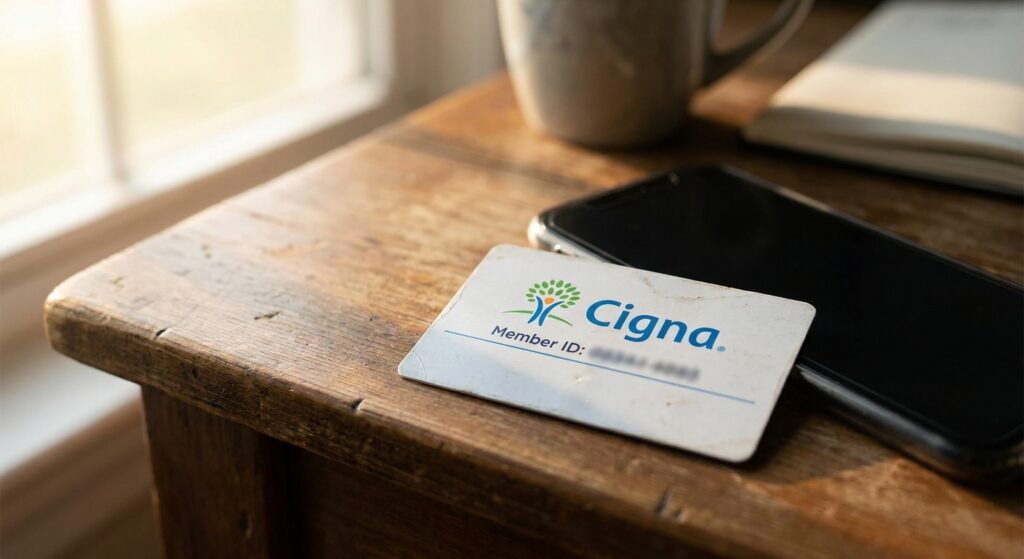
You have looked at the Cigna member card three times today. Maybe it is your own card, or maybe it belongs to your husband, your wife, or the grown son or daughter you have been lying awake worrying about. You know the words printed on the plan papers (deductible, coinsurance, out-of-pocket maximum), but you don’t know what any of them mean for detox, or whether the plan will approve medical withdrawal management at all. The question that keeps you from picking up the phone is simple: how much will this cost, and how fast can someone tell me? If you are looking for a detox that takes Cigna in Maumee, OH, or anywhere in the Toledo area, Midwest Detox Center believes you deserve a straight answer to that question before you commit to anything.
The answer starts here. Midwest Detox Center in Maumee, OH, is confirmed in-network with Cigna, and on the first call the admissions team can typically pull and explain the benefits. If you want to move forward, they can work on getting an approval. You don’t need to understand insurance before you call. All you need is the card and a few minutes. The rest of this page walks you through each step of that call, explains how the team handles pre-authorization, and shows you how to know what you may owe before anyone walks through the door.
What Does It Mean to Find a Detox That Takes Cigna, and Why Does In-Network Matter?
A detox center that is in-network with Cigna has a contract with Cigna that sets the price of its services ahead of time. Midwest Detox Center is confirmed in-network with Cigna, which means the plan’s contracted rate applies and you may avoid out-of-network surprise bills.
Think of it like a store that has already agreed on prices with your insurance company, so nobody argues over the bill later. The plan pays its share at the agreed rate, and you pay your share based on your benefits. An out-of-network facility has no agreement like that. It can charge its full price, the plan may pay only part of it, and the facility can sometimes bill you for the difference. That leftover charge is often called a balance bill, and it is the kind of surprise that stops people from starting treatment at all.
Because of this, it helps to watch the wording when you search. Some websites and directories say a facility “takes” or “works with” Cigna when they really mean the facility will accept out-of-network benefits, and those are not the same thing. Some plans, often HMO or EPO plans, may pay little or nothing for out-of-network care outside of an emergency. When you call any center, ask this exact question: “Are you in-network with my Cigna plan?” At Midwest Detox Center, the answer is yes.
This matters even more for detox than for a doctor’s visit. Medical detox is usually a stay of several days with nurses watching withdrawal around the clock, so costs add up day by day and the gap between an in-network rate and an out-of-network bill can be large. For families in Toledo and the surrounding area, Midwest Detox Center offers in-network Cigna care in nearby Maumee, so you are not forced to choose between a fair price and keeping your loved one near the people who support them.
Can Someone Tell You What Cigna Covers Quickly?
The Midwest Detox Center admissions team asks for three things: the name, the date of birth, and the Cigna member ID. From there they pull the benefits and can walk you through the deductible, out-of-pocket maximum, substance use coinsurance, and approval process.
The call follows the same order every time, and knowing it ahead of time can make picking up the phone feel less frightening:
- You share three things: the name, the date of birth, and the member ID printed on the Cigna card.
- The team pulls the plan’s benefits while you are still on the line.
- They review the deductible and the out-of-pocket maximum first, because those two numbers set the limits on your potential cost.
- They check the substance abuse benefits in the plan and the coinsurance that may apply to that care.
- They explain those benefits to you in plain language. If you want to go ahead, they can work on getting an approval.
You don’t need to have the card memorized or have anything else ready. Maybe your hands are shaking, or you are calling from your car in a parking lot, or you are worn out from another night of waiting for the phone to ring. That is okay. Read the numbers off the card, front and back, and the Midwest Detox Center team handles the rest. You might worry the call will feel like being judged or grilled, whether you are calling for yourself or for someone you love. It won’t. The first few minutes are about the plan, not about everything that brought you here.
If you have ever called a national hotline and been told someone from billing would “get back to you,” this works differently. The benefits check happens during your call with the Midwest Detox Center admissions team in Maumee, not days later through an outside office. You hang up knowing what the plan says instead of waiting by the phone wondering if you can afford to get help.
What Happens If Cigna Requires Pre-Authorization Before Detox?
Pre-authorization is the plan’s approval, given before admission, that detox is medically necessary. If the Cigna plan requires it, the team explains that step up front, and the utilization review (UR) nurse at Midwest Detox Center can work to secure the authorization.
Think of pre-authorization as a permission slip the plan has to sign. Many insurance plans, including some Cigna plans, want proof that a person needs a medical level of care before they agree to pay for it, and that proof has to speak the language reviewers use. Most of that language comes from the ASAM Criteria, the framework clinicians use to match a person with the right level of care. Dimension 1 asks how risky withdrawal is likely to be. This is often the fear families name first: what if withdrawal hurts them? That fear is reasonable, because withdrawal can be a real medical concern and not just discomfort. According to MedlinePlus from the National Library of Medicine, severe alcohol withdrawal can cause seizures and delirium tremens, a serious condition that needs medical care. That is one reason why medically supervised detox exists.
The Midwest Detox Center UR nurse builds the Dimension 1 case from two sources: the intake nurse’s CIWA-Ar or CINA scale results and the person’s documented use history. The CIWA-Ar (Clinical Institute Withdrawal Assessment for Alcohol, Revised) scores alcohol withdrawal symptoms such as tremor, sweating, nausea, and anxiety, and the CINA scale measures opioid withdrawal. If Dimension 1 comes out borderline, the nurse may move to Dimensions 2 and 3, which cover co-occurring medical or psychiatric instability. Payers may review detox requests when acute withdrawal risk and safety concerns are documented, so the nurse puts both in front of the reviewer.
Once the Midwest Detox Center admissions coordinator collects the member ID and basic demographics, the UR nurse runs a benefits check and contacts the insurance company directly. On that first call, the team tells you which ASAM criteria may support the need for detox and gives you a callback window for the authorization decision. The nurse also works from a criteria sheet kept for each major payer, which spells out which dimension that payer’s reviewers tend to weigh.
The final decision belongs to the plan, so the team cannot promise approval. What you get is a nurse who already knows how this paperwork works, and that is the step where many people get stuck when they try to handle it alone. If you or your loved one feels tempted to play down drinking or drug use on the call, try not to. The truth is not held against anyone. It is the documented history that helps the nurse show the plan why safe, medically supervised care may be needed.
What Will You Actually Owe Under Cigna Substance Use Benefits?
What you owe at Midwest Detox Center depends entirely on the Cigna plan’s deductible and out-of-pocket maximum. The center adds no extra fees of any kind, so the maximum listed on your card is the most you would ever owe for covered in-network care.
Many Cigna plans list behavioral health benefits in their own section, apart from general medical care. That section often still carries the older label “substance abuse,” and it may be split into tiers, such as outpatient care and inpatient or facility care. Medical detox usually falls under the inpatient or facility tier, which can have its own coinsurance. This is why the Midwest Detox Center admissions team checks the substance abuse benefits on your plan instead of guessing from the front of the card.
It helps to picture the three numbers that matter in plain terms. The deductible is the amount you pay first, before the plan starts sharing costs. Coinsurance is the share you split with the plan after that, a bit like splitting a check by percentage. The out-of-pocket maximum is the ceiling, and once you reach it, the plan generally pays covered in-network care in full for the rest of the plan year. Timing matters too: if the family has already had medical bills this year, part of the deductible may be paid, so your share could be lower than you expect.
Federal law also works in your favor. The Mental Health Parity and Addiction Equity Act generally requires that plans offering substance use benefits not make them more restrictive than medical and surgical benefits. In practice, detox benefits should follow rules similar to the rest of the coverage. The admissions team does not quote a sticker price and hope for the best. It reads your plan and tells you the numbers, and because nothing gets added on top, the out-of-pocket maximum on your card represents your maximum cost for covered services. If there is no insurance, or the plan does not fit, Midwest Detox Center also accepts private pay, and the team can talk that through on the same call.
Why Detox and Residential Under One Roof Can Mean Fewer Insurance Hurdles
Once the cost question is answered, the next worry is usually what happens after detox ends. Midwest Detox Center offers both medical detox and residential treatment under one roof in Maumee, OH, which may help close a common gap in the process. Cigna benefits can sometimes cover a continuous episode of care without a transfer to a second facility or a fresh start with a new provider.
Detox is where recovery starts, not where it ends. The National Institute on Drug Abuse’s principles of effective treatment state that medically assisted detox is only the first stage of treatment and, on its own, does little to change long-term drug use. What comes next matters as much as getting through withdrawal safely. If your loved one has tried before and slipped back, you may already know where things went wrong, and often it was the days between leaving detox and starting ongoing treatment.
Picture how it goes at a stand-alone detox. Your loved one finishes withdrawal, gets handed a list of phone numbers, and is told to find a residential program, and then the waiting begins. A new facility runs a new benefits check, sends a new authorization request, and asks for the whole history to be repeated to strangers. All of this lands at the moment a person may feel weakest, and every delay is a chance for cravings, old routines, and doubt to take over. For the spouse or parent at home, it can mean another stretch of sleepless nights.
At Midwest Detox Center, that handoff happens in the same building with the same team. The UR nurse who built the detox case already holds the CIWA-Ar or CINA scores, the use history, and the Cigna details. When the care team recommends stepping down to residential treatment for a substance use disorder or alcohol use disorder, that nurse can work with the plan from records already in hand. The plan may still review progress at set points, and residential treatment is its own level of care that may need its own approval, but nobody is starting over with a new provider. This is where some people experience the move from withdrawal into ongoing healing: one medically supervised setting where the transition does not depend on you making another round of calls.
Questions People Ask Before Using Cigna for Detox in Maumee, OH
The answers below cover what people ask most before their first call. Each answer depends on the specific Cigna plan, which the Midwest Detox Center admissions team checks for you.
Is Midwest Detox Center in-network with Cigna?
Yes. Midwest Detox Center is confirmed in-network with Cigna, so the plan’s contracted rate applies and you may avoid out-of-network surprise bills.
How long does it take to verify Cigna benefits for detox?
The Midwest Detox Center admissions team pulls the benefits and explains the deductible, out-of-pocket maximum, and substance use coinsurance while you are still on the line, and can work on getting an approval if you want one.
What is pre-authorization, and does Cigna require it for detox?
Pre-authorization is the plan’s approval that detox is medically necessary. Some Cigna plans require it. When a plan does, the Midwest Detox Center UR nurse contacts Cigna, can work to secure the authorization, and gives you a callback window for the decision.
What will I owe out of pocket if I use Cigna at Midwest Detox Center?
It depends entirely on the plan’s deductible and out-of-pocket maximum. Midwest Detox Center adds no extra fees, so the maximum on your card represents the most you would owe for covered in-network care.
Can my loved one go on to residential treatment after detox and stay covered by Cigna?
Sometimes, yes. Because detox and residential treatment are under one roof at Midwest Detox Center in Maumee, OH, Cigna benefits can sometimes cover a continuous episode of care without a transfer to a second facility. The plan may still review progress along the way.
Can I call for my spouse or adult child?
Yes. Many first calls come from a husband, wife, partner, or parent. You can ask questions and start the benefits check with the information on their Cigna card. Your loved one will need to take part in their own admission, and the team can talk with you about how to approach that conversation.
What information do I need to verify Cigna benefits?
You need the name, date of birth, and Cigna member ID. That is enough to start.
What if we’re not ready to call a treatment center yet?
That is okay. The SAMHSA National Helpline is a free, confidential service that answers 24 hours a day, 365 days a year, and can share treatment information and referrals in English and Spanish. When you are ready to find out what the Cigna plan may pay for detox, the Midwest Detox Center admissions team is a phone call away.
Your Next Step Takes One Call and a Cigna Card
If you have been searching for a detox that takes Cigna in the Toledo area, call Midwest Detox Center in Maumee, OH, at 502-830-3523. The team can verify the Cigna benefits and explain the deductible and coinsurance in plain language. If your plan needs pre-authorization, the team can work to secure it, so you know what you may owe before admission.
Before you dial, grab a pen. During the call, write down three numbers: how much of the deductible is left this year, the coinsurance for substance use facility care, and the out-of-pocket maximum. Those three numbers help answer the cost question. Once they are on paper, the fear of an unknown bill becomes a figure you can see, plan for, and set aside.
You don’t have to make any other decision on that call. You can ask questions, hear the numbers, and take a moment to think. If you are ready, though, the same Midwest Detox Center team that checks the benefits can have the UR nurse reaching out to Cigna. Many families find that knowing the potential cost is what helps them move forward. It turns medically supervised detox, and the residential care that may follow under the same roof, into a step your loved one can consider today instead of another week from now.
Start Your Coverage Check Today
If you’re weighing whether detox is the right step, knowing that your Cigna plan may cover treatment can remove one of the biggest barriers standing between you and recovery. Midwest Detox Center in Maumee verifies benefits quickly and walks you through what your plan includes, so you can make an informed decision without the guesswork. Reach out now to confirm your coverage and explore your options for medical detoxification.
Coverage decisions, timelines, and individual outcomes vary by plan, person, and clinical circumstances. The information above describes one facility’s process and should not be taken as a guarantee of approval, cost, timeline, or treatment result.